Sand Tetris Tips: How the Sand Settles and What Clears
Published · 3 min read
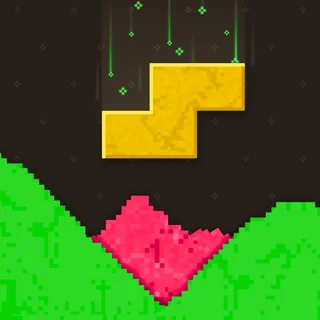
Sand Tetris punishes old Tetris habits. Filling a row does nothing. Stacking neatly does nothing. The shapes do not even rotate. What matters is colour and where sand goes once it breaks apart. This guide covers how the sand behaves, how clears really work, and a routine that keeps the heap under the red line.
How the sand behaves
Each shape falls as a solid block, then bursts into grains the moment it touches the floor or the heap. The grains keep moving for a second or two. They slide down any slope, roll off edges and spread sideways, so a shape dropped on a peak ends up as a wide, low mound. This is the most useful thing to understand about the game: sand spreads, it does not stack. Drop a square next to a wall and it forms a ramp. Drop it into a dip and it fills the dip almost flat.
The well is 94 grains wide and 153 tall. The red line sits near the top. The game ends when the heap reaches it — not when a column is full, because there are no columns, only the height of the pile.
What clears
A clear happens when grains of a single colour form a connected band that touches the left wall and the right wall. The band does not have to be straight or level. It can climb and dip across the heap, a few grains thick, as long as every grain in the path touches the next and all of them are the same colour. When it connects, the whole band flashes and dissolves, and the sand above it pours into the space.
That last part matters. When a band clears, the grains above fall and mix. Sometimes they fall into another band of their own colour and clear that too. You can plan for this by keeping a second colour lying across the heap just above the first.
A routine for every shape
- Check the Next box. You always know two colours: the shape in hand and the one after it. Decide where both should go before you move.
- Put colour on colour. Drop each shape where the same colour already lies, towards the wall it has not reached yet.
- Keep the middle low. Sand from the middle spreads both ways, which is good for bands but raises the centre fastest. Build up from the walls.
- Finish bands with small shapes. A band that stops a few grains short of a wall needs very little sand. Save a small shape for that gap.
- Skip the wrong colour. If a shape would bury the band you are about to finish, press Skip. There is a short cooldown, so do not rely on skipping twice in a row.
Classic or Speeding Up
Classic never hurries you. The shape waits at the top until you press Down, S or Space, or let go of it on a touchscreen. Use Classic to learn how sand settles. Speeding Up starts the shape falling by itself shortly after it appears, and each new shape falls a little faster, from a gentle drift to more than twice the starting speed. In Speeding Up, decide the column as soon as the shape appears and slide there directly.
Ready? Play Sand Tetris, and see the guide to scoring, combos and the two modes.
More from the blog
- Sand Tetris Scoring, Combos and Modes Explained
Where the points come from, how the 15-second double-points combo works, and Classic versus Speeding Up.